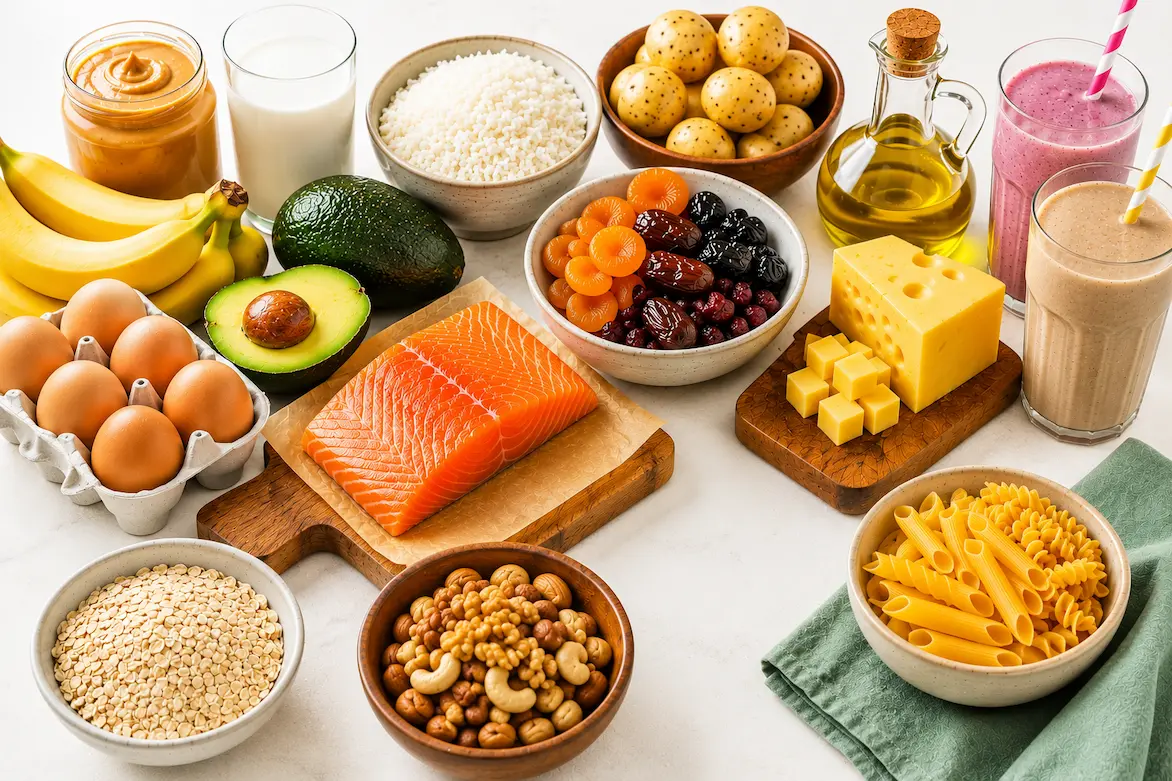
For some people, gaining weight is harder than losing it.
You eat more, snack throughout the day, and still see little change on the scale. Often, the problem isn’t appetite—it’s food volume. Many foods fill the stomach quickly without providing enough calories to create a consistent calorie surplus.
The solution isn’t relying on fast food or sugary snacks. While they can increase calorie intake, they often provide poor nutrition and may promote excess fat gain rather than healthy weight gain.
Instead, focus on calorie-dense foods that also provide protein, healthy fats, complex carbohydrates, vitamins, and minerals. These foods make it easier to increase your calorie intake without forcing yourself to eat massive portions.
High-Calorie Foods for Healthy Weight Gain
The foods below are calorie-dense, practical to eat regularly, and much easier to build into meals without constantly feeling overly full.
1. Peanut Butter
Peanut butter is one of the easiest ways to increase calorie intake without adding much food volume.
Just two tablespoons provide around 190 calories along with healthy fats, some protein, and small amounts of magnesium and vitamin E. It is easy to add to smoothies, oats, toast, bananas, or yogurt.
Natural peanut butter is the better option because heavily processed versions often contain excess sugar and hydrogenated oils.
The biggest advantage is convenience. Few foods deliver this many calories in such a small serving.
2. Whole Milk
Whole milk is useful for people who struggle with low appetite because calories in liquid form are often easier to consume than solid food.
Drinking whole milk alongside meals or blending it into shakes can increase daily calorie intake significantly, with one glass providing nearly 150 calories.
For people trying to gain muscle along with weight, whole milk is especially practical after workouts because it contains both protein and carbohydrates.
3. Rice
Rice is simple, cheap, easy to digest, and highly effective for increasing calories.
Cooked rice provides around 240 calories per cup (186 g) and is easy to eat in larger portions compared to heavier foods like potatoes or dense whole grains.
White rice is often useful for people with smaller appetites because it digests quickly and creates less fullness than high-fiber foods.
Pairing rice with protein and healthy fats makes meals much more calorie-dense without becoming overwhelming.
4. Nuts
Almonds, walnuts, cashews, pistachios, and peanuts are among the best snack options for weight gain.
Nuts contain large amounts of calories from healthy fats while also providing protein, magnesium, and other micronutrients.
A small handful can easily provide 150 to 200 calories. That matters because people trying to gain weight usually fail from low total calorie intake, not lack of meal frequency.
Nuts are also portable, which makes consistent eating easier throughout the day.
5. Avocados
Avocados are rich in monounsaturated fats, making them naturally high in calories.
A single cup (150 g) of avocado provides around 240 calories depending on size. Unlike heavily processed high-calorie foods, avocados also provide fiber, potassium, and beneficial plant compounds.
They work well in sandwiches, rice bowls, eggs, smoothies, and salads.
The combination of calories and nutrients makes them far more useful than empty-calorie snack foods.
6. Eggs
Eggs are one of the most balanced foods for healthy weight gain because they provide both calories and high-quality protein.
The yolk matters. Many people trying to gain weight still avoid egg yolks because of outdated nutrition fears. A whole egg provides about 72 calories along with protein and fat, making eggs far more effective for increasing calorie intake than egg whites alone.
Whole eggs provide protein, fat, choline, vitamin B12, selenium, and other nutrients important for recovery and muscle growth.
They are also versatile and easy to include in multiple meals daily.
7. Cheese
Cheese is highly calorie-dense because it combines fat and protein in a compact form. Many hard cheeses provide around 100–120 calories per ounce, making them an easy way to increase calories without adding much food volume.
Adding cheese to sandwiches, eggs, pasta, rice dishes, or potatoes can increase calories quickly without increasing meal size dramatically.
It also provides calcium and protein, which support muscle and bone health.
Hard cheeses like cheddar and parmesan are especially calorie-dense compared to softer varieties.
8. Bananas
Bananas are practical for weight gain because they provide easy-to-digest carbohydrates, with one medium banana (115 g) containing around 113 calories.
They are especially useful before workouts or as part of smoothies because they increase calories without creating excessive fullness.
Combining bananas with peanut butter, milk, oats, or yogurt creates a much higher-calorie meal with very little effort.
For people with low appetite, this matters more than eating massive heavy meals.
9. Oats
Oats are often associated with weight loss, but they work extremely well for weight gain when prepared properly. One cup (80 g) of dry oats provides around 300 calories before adding milk, nuts, or other ingredients.
The problem is that many people eat plain oats with water and no calorie-dense additions. That creates fullness without enough calories.
Oats become effective for weight gain when combined with milk, nuts, seeds, peanut butter, dates, honey, or fruit.
They also provide complex carbohydrates, fiber, iron, and magnesium.
10. Olive Oil
Olive oil is one of the simplest ways to increase calories without increasing food volume.
One tablespoon (14 g) contains around 126 calories. Drizzling olive oil over rice, vegetables, pasta, eggs, or salads can significantly increase calorie intake with minimal effort.
This is useful for people who feel full quickly and cannot tolerate large meals.
Extra virgin olive oil also provides beneficial monounsaturated fats and antioxidant compounds.
11. Potatoes
Potatoes are often underestimated for weight gain because people associate them with dieting.
In reality, potatoes become highly effective calorie sources when paired with fats and protein. One medium potato (167 g) provides around 144 calories before adding butter, cheese, or oil.
They are rich in carbohydrates, potassium, and vitamin C while also being easy to prepare in large portions.
Mashed potatoes with butter, cheese, olive oil, or ground meat can become extremely calorie-dense meals.
12. Dried Fruits
Dried fruits like dates, raisins, figs, and apricots contain concentrated calories because most of the water has been removed. Depending on the type, a 30-gram serving can provide around 70–100 calories.
That means you can eat far more calories in a small portion compared to fresh fruit.
Dates are especially useful because they combine quickly digestible carbohydrates with minerals like potassium and magnesium.
Dried fruits also work well in shakes, oatmeal, yogurt, or trail mixes.
13. Salmon
Salmon helps support healthier weight gain because it provides calories along with high-quality protein and omega-3 fats. A 100-gram serving of cooked Atlantic salmon provides around 206 calories.
The combination is useful for people trying to build muscle rather than simply gain body fat.
Fatty fish also supports recovery and overall nutrition better than relying heavily on processed calorie sources.
Salmon pairs well with rice, potatoes, or pasta for higher-calorie meals.
14. Dark Chocolate
Dark chocolate is calorie-dense due to its fat content, with a 1-ounce (28-gram) serving providing around 170 calories, but quality matters.
Chocolate with higher cocoa content generally contains less sugar and more beneficial plant compounds than heavily processed milk chocolate candy.
It is an easy way to increase calories through snacks, smoothies, or desserts without relying entirely on ultra-processed junk food.
Portion control still matters because calories add up quickly.
15. Smoothies and Homemade Weight Gain Shakes
Liquid calories are often the missing piece for people struggling to gain weight.
A homemade shake can easily provide 600 to 1000 calories without feeling as filling as a large solid meal.
The key is ingredients. Most commercial “mass gainers” are overloaded with sugar and cheap fillers.
A better approach is combining calorie-dense whole foods like:
- whole milk
- oats
- bananas
- peanut butter
- yogurt
- nuts
- dates
This creates a balanced shake with carbohydrates, protein, and healthy fats instead of empty calories.
16. Greek Yogurt
Greek yogurt works well for weight gain because it combines calories with a high amount of protein in a relatively small serving. A 200-gram serving of full-fat Greek yogurt provides about 190 calories.
Full-fat versions are much more effective than low-fat options because the added fat increases calorie density significantly. It also pairs easily with granola, nuts, honey, fruits, or peanut butter, turning a simple snack into a high-calorie meal.
Another advantage is convenience. Many high-calorie foods require preparation, but Greek yogurt is easy to eat even when appetite is low.
For people trying to gain muscle along with body weight, the protein content makes it especially useful.
17. Pasta
Pasta is one of the easiest carbohydrate sources for increasing calorie intake consistently.
It is calorie-dense, with one cup (124 g) of cooked pasta providing about 200 calories, while also being affordable, easy to prepare in large portions, and easy to combine with protein and fats.
Pasta becomes far more effective for weight gain when paired with olive oil, cheese, creamy sauces, ground meat, salmon, or pesto.
Another reason pasta works well is digestibility. Many people can comfortably eat more pasta than bulky high-fiber foods, which helps increase overall calorie intake without excessive fullness.
18. Trail Mix
Trail mix is effective because it combines several calorie-dense foods into one compact snack. A 1.5-ounce (42-gram) serving can provide around 200 calories depending on the ingredients.
Most mixes contain nuts, seeds, dried fruits, and sometimes dark chocolate, creating a combination of fats and carbohydrates that delivers substantial calories quickly.
This matters because snacks are often where underweight individuals fall short. Meals alone may not provide enough energy intake for weight gain.
The biggest advantage is portability. Carrying trail mix makes it easier to eat consistently throughout the day instead of relying entirely on large meals.
Store-bought versions with excessive candy and added sugar are less useful than simpler mixes built around nuts and dried fruit.
19. Coconut Milk
Coconut milk is extremely calorie-dense because of its fat content, with half a cup providing around 220–230 calories. A full cup (226 g) can provide around 445 calories, making it one of the easiest ways to increase calorie intake without adding much food volume.
Even small amounts can significantly increase calories in curries, soups, rice dishes, smoothies, or oatmeal without increasing food volume much. This is useful for people who struggle with appetite or feel overly full from large meals.
Unlike many processed high-calorie ingredients, coconut milk also adds texture and flavor, making meals easier to eat consistently.
The biggest advantage is how easily coconut milk increases calories without requiring large portions of food.
20. Cottage Cheese
Cottage cheese is often overlooked for weight gain because people associate it with dieting, but full-fat versions can work extremely well. A one-cup (220 g) serving can provide around 230 calories along with a high amount of protein.
It provides a combination of calories and slow-digesting protein, which helps support muscle recovery and sustained energy intake.
Cottage cheese also works in both sweet and savory meals. It can be eaten with fruit, nuts, honey, toast, potatoes, or eggs, making it easy to include multiple times throughout the day.
For people trying to gain healthy body weight rather than relying heavily on ultra-processed foods, it is one of the more practical high-protein options.
Why Some People Still Fail to Gain Weight
The biggest reason is inconsistency.
Many people eat aggressively for one or two days and then unintentionally undereat afterward because large meals become exhausting.
Weight gain depends on average calorie intake over time, not occasional overeating.
The second issue is relying too heavily on low-calorie “healthy foods.” Huge salads, broth soups, plain vegetables, and lean protein are nutritious, but they are not efficient for people who need more calories.
The third issue is poor meal structure. Waiting until you feel extremely hungry usually backfires because appetite is often unreliable in naturally thin individuals.
Structured eating works better than intuitive eating when weight gain is the goal.
How to Increase Calories Without Feeling Overstuffed
The smartest strategy is calorie layering.
Instead of doubling portion sizes, increase calories within the meals you already eat.
Examples:
- Add olive oil to rice or vegetables
- Add peanut butter to oats or smoothies
- Use whole milk instead of water
- Add cheese to eggs or potatoes
- Snack on nuts and dried fruits
This raises calorie intake without dramatically increasing fullness.
Liquid calories also help because they digest faster and usually create less satiety than solid food.T
The Bottom Line
Healthy weight gain is not about eating everything in sight.
The goal is increasing calories efficiently while still supporting recovery, digestion, energy, and muscle growth.
The foods above work because they provide substantial calories without forcing excessive food volume. They also make it easier to maintain a consistent calorie surplus, which is what actually drives weight gain over time.
Focus on calorie-dense whole foods, eat consistently, and stop relying on random junk food as the primary strategy. That approach usually creates poor-quality weight gain and becomes difficult to sustain.