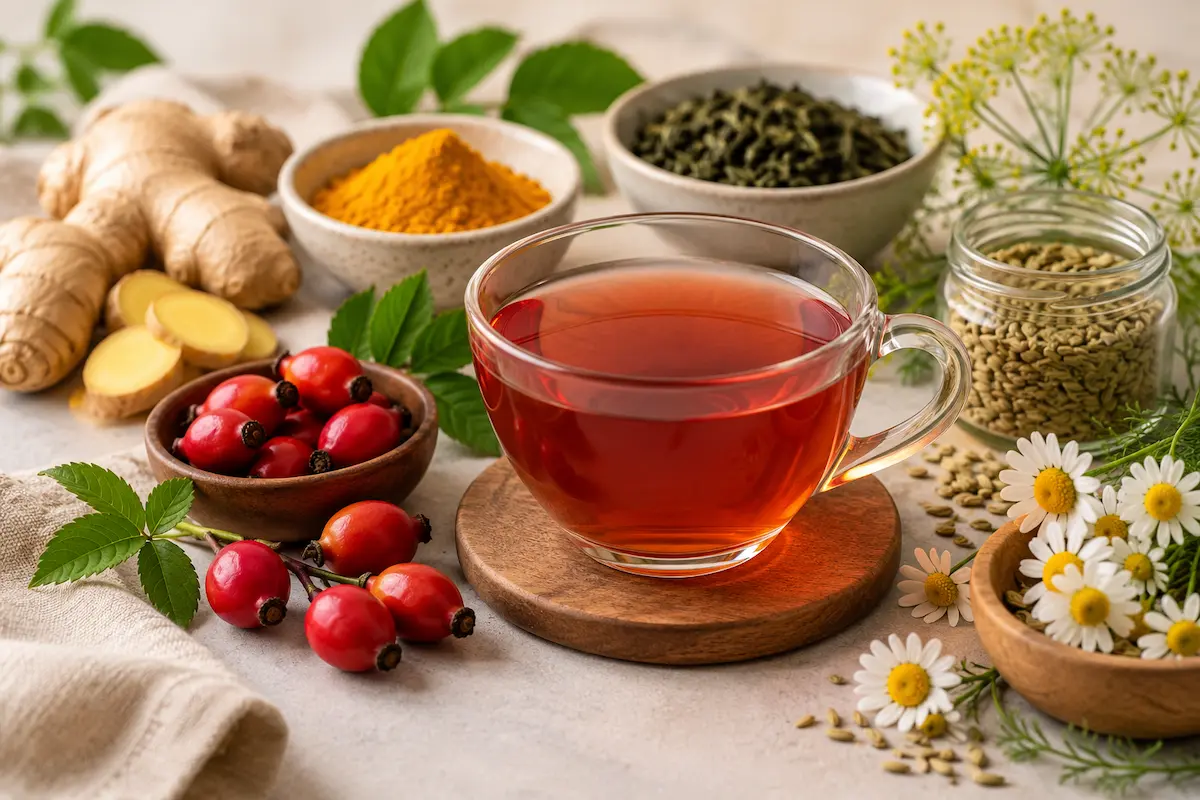
Inflammation is a normal part of your body’s defense system, but persistent inflammation can become a concern. That has made “anti-inflammatory” foods and drinks increasingly popular, especially herbal teas.
But not every tea marketed for inflammation has strong evidence behind it.
Some teas contain plant compounds that have been studied in human clinical trials, while others rely mostly on traditional use or laboratory research. There is also an important distinction between research on a concentrated herbal extract and research on an ordinary cup of brewed tea.
In this article, we’ll look at six teas that may have anti-inflammatory properties, what the research actually shows, and what you can realistically expect from a cup of tea.
Teas That May Help Lower Inflammation
These are six teas with potential anti-inflammatory properties, but there’s one important point to keep in mind: much of the research on these ingredients involves supplements, extracts, or standardized preparations rather than ordinary brewed tea. So, the findings don’t always tell us exactly what you can expect from a cup of tea.
1. Ginger Tea
Ginger tea is one of the more interesting choices when you’re looking for a tea made with an ingredient that has been studied for its potential anti-inflammatory effects.
Ginger contains bioactive compounds such as gingerols and shogaols, which have been investigated for their effects on inflammatory pathways.
So, does the research actually support ginger?
Somewhat. Research on ginger supplementation suggests it may reduce certain inflammatory markers, including C-reactive protein (CRP) and tumor necrosis factor-alpha (TNF-α). A 2020 review found significant reductions in CRP, hs-CRP, and TNF-α, although it did not find significant effects on IL-6 or sICAM.
A newer 2025 review also found reductions in CRP, TNF-α, and IL-6, along with improvements in several antioxidant markers. However, the researchers noted substantial variation between studies, so the results should be interpreted cautiously.
The catch is that most of this research involves ginger supplements rather than ginger tea. So you shouldn’t assume that a cup of ginger tea provides the same effects as the doses used in these trials.
How to make ginger tea
Add several slices of fresh ginger to hot water and steep for about 5 to 10 minutes.
You can add lemon for flavor or drink it plain.
2. Turmeric Tea
Turmeric is another popular choice because it contains curcumin, a compound extensively studied for its potential effects on inflammation.
And there’s quite a bit of research behind it.
An umbrella meta-analysis showed that curcumin supplementation significantly reduced levels of CRP, IL-6, and TNF-α. However, the researchers noted variation between studies, so the findings should be interpreted with some caution.
The important thing to remember is that turmeric tea doesn’t necessarily provide the same amount of curcumin used in these studies. Homemade turmeric tea can contain considerably less curcumin than standardized supplements.
So turmeric tea can be a simple way to include turmeric in your diet, but it shouldn’t be viewed as equivalent to a curcumin supplement.
How to make turmeric tea
Mix turmeric with hot water and add fresh ginger, cinnamon, or a small amount of black pepper for flavor.
You can also make a turmeric latte using milk or a fortified plant-based milk.
3. Green Tea
Green tea contains catechins, particularly epigallocatechin gallate (EGCG), which have been extensively studied for their antioxidant and biological effects.
Green tea also has a much larger research base than many herbal teas. However, the evidence for its effects on inflammation is mixed.
A meta-analysis of 38 trials found that green tea supplementation improved several measures of antioxidant status. However, among the inflammatory markers studied, only IL-1β was significantly reduced, while CRP, IL-6, and TNF-α were not. The researchers noted that the IL-1β finding was based on only two studies and should be interpreted cautiously.
So green tea has plenty of human research behind it, but its anti-inflammatory effects aren’t as well established as its popularity might suggest.
How to drink green tea
Steep a green tea bag or loose leaves in hot, but not boiling, water for several minutes.
Avoid adding large amounts of sugar if you’re drinking it regularly.
Because green tea contains caffeine, it may be better earlier in the day if caffeine affects your sleep.
4. Rosehip Tea
Rosehip is an interesting option because it contains polyphenols, vitamin C, carotenoids, and other plant compounds with antioxidant activity.
Human studies have mainly investigated standardized rosehip preparations in people with osteoarthritis. A 2008 meta-analysis of three trials involving 287 people found that rosehip powder reduced osteoarthritis pain compared with placebo.
But that doesn’t tell us that rosehip tea reduces inflammation. Evidence for inflammatory markers is limited, and most studies have used rosehip powder or standardized preparations rather than brewed tea.
So rosehip tea can be a caffeine-free way to enjoy rosehip’s plant compounds, but its anti-inflammatory effects remain uncertain.
How to enjoy rosehip tea
Steep dried rosehips or a rosehip tea bag in hot water according to the product instructions.
Its naturally tart flavor pairs well with lemon or a small amount of honey.
5. Fennel Tea
Fennel is an interesting option, but its human research is more specific than evidence for general inflammation.
Interestingly, fennel has been studied particularly for primary dysmenorrhea, or menstrual pain. A 2020 review showed that fennel reduced menstrual pain similarly to conventional medications and more than placebo, although the researchers noted some limitations in the available evidence.
Fennel also has laboratory research suggesting anti-inflammatory activity, but that doesn’t establish that fennel tea reduces inflammation in people.
So fennel is better viewed as a tea with some human evidence for menstrual pain than as a proven anti-inflammatory tea.
How to make fennel tea
Lightly crush fennel seeds and steep them in hot water for several minutes.
Strain before drinking.
6. Chamomile Tea
Chamomile tea is best known as a calming, caffeine-free drink, but it has also attracted interest for its potential anti-inflammatory effects.
Chamomile contains flavonoids and other plant compounds with antioxidant and anti-inflammatory activity. Human research is beginning to explore these effects, although the evidence is still limited.
A 2025 review indicates that chamomile reduced pain and mucositis severity in some clinical settings, suggesting potential anti-inflammatory effects. However, these studies don’t show that drinking chamomile tea lowers general inflammatory markers such as CRP or IL-6.
For now, chamomile is better viewed as a caffeine-free beverage with some promising research behind it rather than a proven treatment for chronic inflammation.
How to make chamomile tea
Steep dried chamomile flowers or a chamomile tea bag in hot water for several minutes.
Drink it plain or add a small amount of honey if desired.
Learn more: 10 Anti-inflammatory drinks to add to your diet.
Are Anti-Inflammatory Teas Safe?
Most commonly consumed teas are well tolerated in moderate amounts, but herbal products aren’t automatically risk-free.
Some herbs can interact with medications or affect certain health conditions.
Be particularly careful with concentrated herbal extracts and supplements, which can provide much higher amounts of active compounds than a normal cup of tea.
Talk with a healthcare professional before regularly using medicinal amounts of herbal products if you:
- Take prescription medications
- Are pregnant or breastfeeding
- Have liver or kidney disease
- Have a bleeding disorder
- Are preparing for surgery
- Have a chronic medical condition
In Conclusion
Some teas have more evidence behind them than others. Ginger and turmeric have the strongest evidence for effects on inflammatory markers, while green tea, rosehip, fennel, and chamomile have more limited or specific evidence.
Most importantly, research on a supplement or concentrated extract doesn’t necessarily apply to an ordinary cup of brewed tea.
Tea can be part of a healthy lifestyle, but it isn’t a substitute for the habits that have a much greater impact on long-term health.