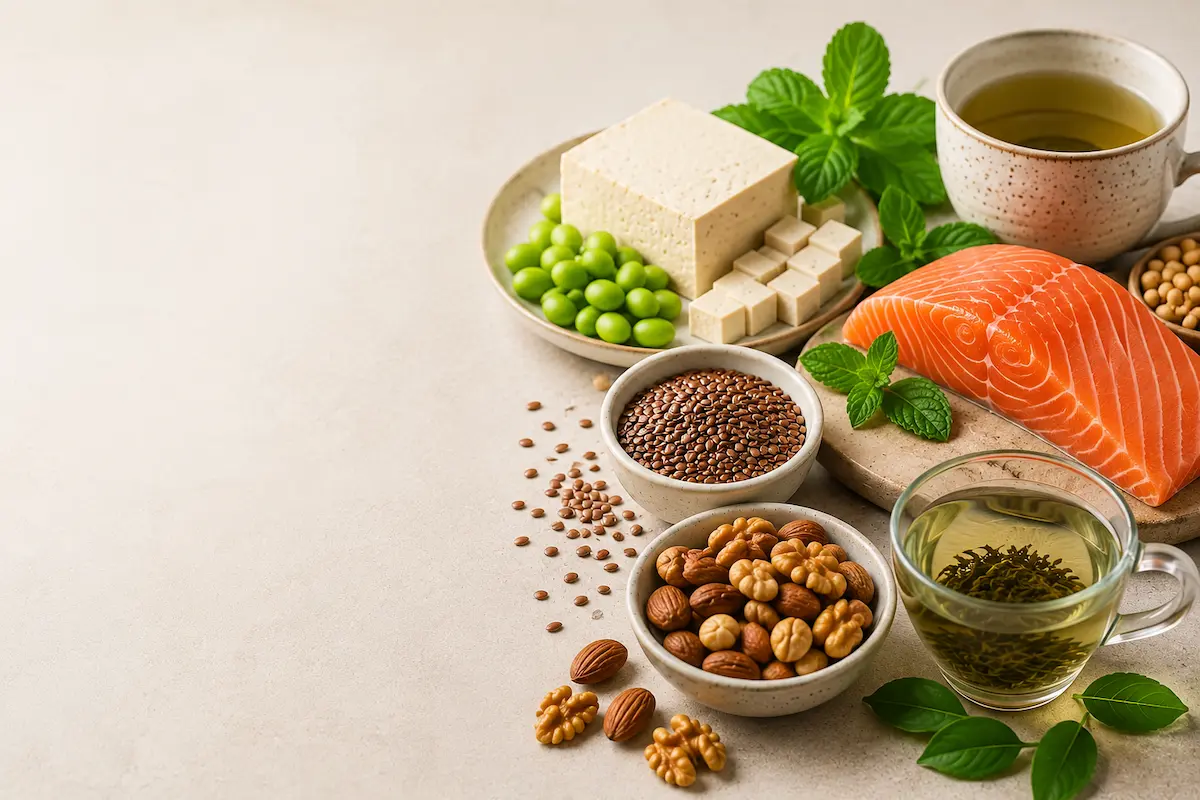
High testosterone in women can show up as acne, unwanted facial or body hair, scalp hair thinning, irregular periods, or difficulty becoming pregnant. This is particularly common with conditions such as PCOS.
While some foods are promoted as natural “testosterone blockers,” no single food has been proven to dramatically lower testosterone.
However, certain foods and dietary patterns may support healthier hormone balance by improving insulin sensitivity, reducing inflammation, and supporting hormone metabolism.
Here’s what the research says about foods that may help support healthy testosterone levels and where the evidence stands.
Can Diet Really Help Lower Testosterone?
The short answer is it may, but food isn’t a quick fix.
Most research has focused on women with PCOS, where insulin resistance can contribute to higher androgen levels. Improving insulin sensitivity through a balanced diet, regular physical activity, and maintaining a healthy weight may help support healthier testosterone levels in some women.
However, high testosterone isn’t always caused by PCOS. Certain medications, other hormonal conditions, and, rarely, ovarian or adrenal tumors can also cause elevated testosterone.
Persistent symptoms such as irregular periods, excessive facial hair, rapid scalp hair loss, or a deepening voice should be evaluated by a healthcare professional.
Rather than relying on a single “testosterone-lowering” food, focus on an overall eating pattern that supports metabolic and hormonal health.
Learn more: Foods that may support hormonal balance in women
Foods That May Help Lower Testosterone
The evidence isn’t equally strong for every food, but several have shown promising effects on testosterone or the metabolic factors that influence hormone balance. Here’s what the research says about the options worth considering.
1. Soy Foods
Soy foods often get a bad reputation when it comes to hormones, but the science is more nuanced than many claims suggest.
Soybeans contain isoflavones, a type of phytoestrogen. Despite the name, phytoestrogens aren’t the same as human estrogen. They can interact with estrogen receptors, but their effects are much weaker and more complex.
So, can soy affect testosterone?
Research in women, particularly those with PCOS, suggests it may. A 2020 review found that soy isoflavones significantly reduced total testosterone in women with PCOS, but did not significantly affect FSH. The researchers noted that better-quality studies are needed to confirm these findings.
Soy can still be a nutritious addition to your diet. Soy foods provide plant protein, vitamins, and minerals, while minimally processed options such as tofu, tempeh, and edamame can support an overall healthy eating pattern.
Also read: 12 Foods high in phytoestrogens
2. Spearmint Tea
Although it’s a beverage rather than a food, spearmint tea deserves a place on this list because it has some of the more direct human research on testosterone and androgen levels in women.
In a small study of 21 women with hirsutism, including women with PCOS, drinking spearmint tea twice daily for five days significantly reduced free testosterone, although total testosterone did not change significantly.
A later 30-day trial involving 42 women with PCOS found that drinking spearmint tea twice daily significantly reduced free and total testosterone. Participants also reported less severe hirsutism, although the objective measure of hair growth did not significantly differ from the placebo group.
These findings are promising, but the studies were small and short, so larger and longer trials are needed to determine whether spearmint tea can produce meaningful, lasting changes in testosterone or excess hair growth.
Spearmint tea can still be a simple, unsweetened beverage to include in a balanced diet. Just don’t treat it as a replacement for medical care or expect it to dramatically change hormone levels on its own.
3. Fatty Fish
Fatty fish such as salmon and sardines are best known for their omega-3 fatty acids, which may also support metabolic and hormonal health.
This may be particularly relevant for women with PCOS, where insulin resistance is common and can contribute to hormonal imbalances. Research on testosterone is also promising.
A meta-analysis of 10 trials in women with PCOS found that omega-3 supplementation reduced total testosterone, LH, inflammation, and oxidative stress, while increasing SHBG. It did not significantly affect DHEAS, FSH, or free androgen index.
SHBG is a protein that binds to testosterone in the blood. When more testosterone is bound to SHBG, less is available in its free, active form.
However, most of this research has examined omega-3 supplementation rather than fatty fish itself, so these findings shouldn’t be interpreted as proof that eating salmon or sardines directly lowers testosterone.
4. Green Tea
Green tea contains natural compounds called catechins, particularly epigallocatechin gallate (EGCG), which have antioxidant and anti-inflammatory properties.
A 2021 review of women with PCOS found that tea supplementation improved several metabolic markers. In a subgroup analysis, green tea was also associated with lower free testosterone, although the evidence remains limited.
A study in 60 overweight women with PCOS found that green tea consumption significantly reduced body weight, fasting insulin, and free testosterone compared with placebo, suggesting potential benefits for metabolic health and hormone balance.
Green tea may therefore be a healthy beverage choice for women with PCOS, but it shouldn’t be considered a proven testosterone-lowering treatment.
Choosing unsweetened green tea instead of sugary drinks can also help reduce added sugar intake..
5. Nuts
Nuts provide healthy fats, plant protein, fiber, vitamins, and minerals that can support overall health.
They may also be relevant to hormone health in women with PCOS. In a six-week trial of 31 women with PCOS, walnuts increased SHBG, while almonds reduced the free androgen index, a measure related to testosterone activity.
These findings are promising, but the study was small and short, so more research is needed.
For now, nuts are best viewed as a nutritious part of an overall diet rather than a direct testosterone-lowering food.
6. Flaxseeds
Flaxseeds are rich in lignans, plant compounds that may influence hormone metabolism. They also provide fiber and alpha-linolenic acid (ALA), a plant-based omega-3 fatty acid.
One small case study offers some preliminary evidence. A 31-year-old woman with PCOS consumed about 30 g of flaxseed daily for four months. Her total testosterone decreased from 150 to 45 ng/dL, while free testosterone fell from 4.7 to 0.5 ng/dL. She also reported less hirsutism.
However, this was a single-person case study without a control group, so it cannot show that flaxseed caused these changes.
A 12-week trial in 70 women with PCOS found that 30 g of milled flaxseed daily increased FSH and lowered the LH/FSH ratio, but did not significantly change several other reproductive hormone markers, including DHEAS and androstenedione.
DHEAS and androstenedione are androgens, or hormones related to testosterone.
Overall, there isn’t enough evidence to say that flaxseed reliably lowers testosterone in women, although its potential effects on hormone and metabolic health warrant further research.
Quick tip: Whole flaxseeds often pass through the digestive system without being fully broken down. Ground flaxseeds are generally better absorbed and may provide more nutritional benefits.
What About Licorice?
Licorice has been studied for its potential effects on testosterone and other hormones.
In a small study of nine healthy women, taking 3.5 g of licorice daily for two menstrual cycles significantly lowered total testosterone. Testosterone returned to its original level after stopping, while other androgen hormones remained unchanged.
More recently, an 8-week trial in 66 women with PCOS found that 1.5 g of licorice extract daily, taken alongside a low-calorie diet, produced greater improvements in total testosterone, FSH, and the LH/FSH ratio than placebo plus the same diet.
These findings are promising, but the research is still limited, and the studies used specific amounts of licorice or licorice extract.
Licorice also isn’t suitable for everyone, as excessive intake can raise blood pressure and lower potassium levels.
When Should You See a Doctor?
Diet can play an important role in supporting hormone health, but it isn’t a substitute for medical evaluation.
If you notice symptoms that may suggest high testosterone or androgen excess, it’s important to identify the underlying cause rather than assuming food alone will solve the problem.
Consider speaking with a healthcare professional if you have:
- Irregular or absent menstrual periods
- Excessive facial or body hair (hirsutism)
- Persistent acne that doesn’t respond to treatment
- Thinning hair or increased hair loss on the scalp
- Difficulty becoming pregnant
- Sudden deepening of the voice
- Rapid muscle gain without an obvious cause
- Enlargement of the clitoris
These symptoms may be related to PCOS, but they can also occur with other medical conditions that require evaluation.
Symptoms that develop suddenly or progress rapidly, particularly voice deepening or clitoral enlargement, should be evaluated promptly. evaluation and treatment.
Frequently Asked Questions
Which food lowers testosterone the fastest?
There isn’t a food proven to lower testosterone quickly. Some studies suggest foods and beverages such as soy, spearmint tea, and flaxseed may influence androgen levels, but the research is limited and any changes are unlikely to happen overnight.
Can diet alone treat high testosterone?
Usually not.
Diet may support healthier hormone and metabolic function, particularly in women with PCOS or insulin resistance, but treatment depends on the underlying cause of elevated testosterone. Some women may also need medications or other treatments recommended by a healthcare professional.
Should I avoid dairy if I have high testosterone?
Not necessarily.
There isn’t enough evidence to recommend avoiding dairy solely to lower testosterone. Unless you have a dairy allergy, lactose intolerance, or another medical reason to avoid it, dairy can be part of a balanced diet.
Can supplements lower testosterone naturally?
Some supplements are marketed as natural testosterone blockers, but many haven’t been adequately studied in humans. Some can also interact with medications or cause side effects. Talk with a healthcare professional before taking supplements, particularly if you have a hormonal condition.
The Bottom Line
No single food has been proven to dramatically lower testosterone in women.
However, foods such as soy, spearmint tea, fatty fish, nuts, flaxseeds, and other nutrient-rich foods may support hormonal and metabolic health as part of a balanced diet.
If you have symptoms of high testosterone, such as irregular periods, excessive facial hair, acne, or unexplained hair thinning, speak with a healthcare professional. Finding and treating the underlying cause is more important than relying on any single food.